American Hospital Association’s Hospital Against Violence Campaign

The AHA 's Hospitals Against Violence Hope (#HAVhope) Friday is a digital media campaign focused on bringing national attention to ending all forms of violence and encouraging hospitals, health systems and community organizations to stand together against violence. Become a supporter by tweeting or submitting a photo that highlights your efforts of combatting violence in the community you serve.

Eugene WoodsThe June 9 HAVhope Day of Awareness is an outgrowth of a Hospital Against Violence campaign initiated by the AHA Board of Trustees to give voice to hospital efforts that combat violence in their communities and their facilities. While violence is different from one community to another, it has become a major public health and safety issue for nearly everyone in our country. In fact, according to the Centers for Disease Control and Prevention (CDC), more than 2.3 million people are treated in U.S. emergency departments each year for violent injuries and violence costs more than $85 billion annually in medical expenses and lost productivity. What is constant, however, is the commitment of hospitals and health systems in helping their employees, patients and communities address violence in whatever form it may take.

Quick Facts:

More than 55,000 deaths and 2.5 million violence-related injuries occur every year (AHA)
On average, nearly 20 people per minute are physically abused by an intimate partner in the United States (NCADV)
12 percent of nonprofit hospitals identified community violence prevention as a priority need in their community health needs assessment (AHA)

Podcasts on Violence Prevention

As part of the Hospitals Against Violence campaign, the AHA interviewed various hospitals across the country that have institutionalized a violence prevention program upon learning violence is a prominent health issue in the communities they serve. Listen to some initiatives hospitals have adopted to combat violence in their community.
Honoring Choices “Everyone, Everyday” Initiative

Make a plan for quality care today & everyday. The “Everyone, Everyday” initiative reaches out to all adults to make a personal health care plan within their own language, culture and ability, and receive the best possible care today and everyday, starting at 18 years old and continuing all through their lifetime.

Make Your Plan. Then, Help Move it Forward! You can start to make your own personal health care plan and put it into action with your care providers using the free Honoring Choices Getting Started Tool Kit. Then, inform and empower your family members, friends, neighbors and all adults in your community — anywhere adults live, work and gather. It’s easy to do. We’ll provide the free tools and programs.

Everyone can help: community groups, faith and cultural groups, and local business can get involved. Your support can help us reach all Massachusetts adults to open the door to health care planning and improve quality care for all.

Here’s how it works:

BMC Links Patients to Outpatient Addiction Treatment Services

Caregivers at Boston Medical Center (BMC) have released a study outlining how the hospital’s Addiction Consult Service (ACS) may be making a significant dent in the problem of inpatients with substance use disorder (SUD) relapsing into addiction – and being readmitted – shortly after discharge.

Numerous studies have shown that many inpatients (15% by one Massachusetts study) have an active SUD, and that they’re likely to be readmitted within 30 days of discharge. But treating a patient for substance use disorder in addition to whatever other forms of treatment the hospital is providing often does not occur.

“Barriers to inpatient initiation of medications for [opioid use disorder] include the limited availability of outpatient providers and programs, lack of insurance coverage, and federal privacy regulations that make coordinating and integrating medical and addiction care difficult,” BMC researchers wrote in the Journal of Substance Use Treatment.

To address the problem, BMC created its Addiction Consult Service in July 2015. The physician-RN ACS team meets with the patient, provides brief bedside counseling, initiates addiction-treatment medications, and formulates discharge planning.

“Discharge work for the ACS included collaborating with the primary hospital medical team, social work, and hospital case management, as well as coordination with and linkage to post-discharge addiction providers,” according to the study. “The ACS regularly collaborated with social work within the hospital and held weekly joint rounds with the Psychiatry Consult and Liaison service.”

Two BMC outpatient clinics and three local methadone clinics were the main post-discharge linkages.

BMC reports that over the first 26 weeks, the ASC received 367 referrals resulting in 337 consults. (Some patients left against medical advice, refused to be seen, etc.)

“Like heart disease can cause a heart attack or a stroke, addiction causes many acute injuries requiring immediate attention, but we can’t simply treat that issue without delving deeper to address the root cause,” said Alex Walley, MD, MSc, a general internist at BMC’s Grayken Center for Addiction who also oversees the addiction medicine fellowship. “Our goal is to engage willing patients in treatment and work with them on a plan that will keep them healthy and safe now and in the future.”

MHA’s V.P. of Clinical Affairs Pat Noga, RN, FAAN, who is involved in the association’s work on opioids, said BMC’s ACS work is well-known within the caregiving community and provides a template for work by other hospitals or state efforts going forward.

Click on the link to read the full study: Addiction consultation services – Linking hospitalized patients to outpatient addiction treatment.

And click here to read about the efforts of MHA’s Substance Use Disorder Prevention and Treatment Task Force that has developed guidelines for hospital to use in addressing the opioid crisis.

MHA’s CARE Act Guidance – Updated Materials

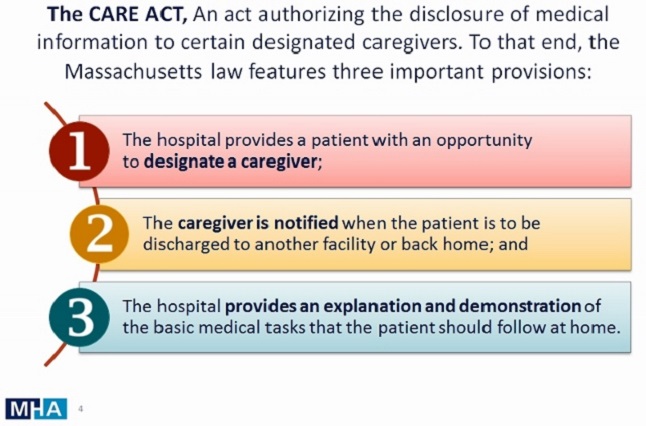
The Caregiver Advise, Record & Enable (CARE) Act (Chapter 332 of the Acts of 2016), effective November 8, is intended to allow patients over the age of 18, who have been admitted as an inpatient at an acute care hospital, to designate a caregiver and give permission for the hospital to provide medical information to that caregiver.

Materials, Fact Sheet and FAQs can be found here…


Preventing Substance Use Starts at Home-Safeguarding Your Children

When it comes to drugs and alcohol, many parents worry aboutinfluences from the outside world, like the media and their
children’s friends. But what can be found inside your home is just as important — youth say that the family home can be a major
source of substances like prescription drugs, alcohol, and inhalants.

Take a tour of your home >>>>

Take steps to protect your children:

  • Learn about risky substances, and how to safeguard your children.
  • Go through your home and identify substances that might be misused.
  • Replace or remove risky products when possible.
  • Put risky substances in secure places and supervise your children if they have to use them.
  • Watch your children for possible signs of misuse. Talk about your concerns, and get help if needed.

Get the Preventing-Drug-Abuse-Starts-at-Home - Safeguarding Your Children here... 


7 Ways to protect your Teens from Alcohol & Other Drugs – A Parent’s Guide

  1. BE A ROLE MODEL

    Teens watch their parents. Your example helps to guide their choices.

  2. BE CLEAR ABOUT YOUR EXPECTATIONS

    The most common reason young people give for not using alcohol and drugs is not wanting to harm their relationship with adults in their lives.

  3. SET LIMITS AND FOLLOW THROUGH

    Teens whose parents set clear rules and follow through with consequences are less likely to use alcohol and other drugs.

  4. BE INVOLVED IN YOUR KID’S LIFE

    Teens are much less likely to use drugs when parents are involved in their lives.

  5. HELP YOUR TEEN BECOME WELL-ROUNDED

    Teens who participate in community service and extracurricular activities are less likely to be involved with drugs and alcohol.

  6. ENCOURAGE YOUR TEEN TO TRY HARD IN SCHOOL

    Teens that perform well in school are less likely to become involved with alcohol and drugs.

  7. REACH OUT

    It takes a village. Teens that have support from a variety of adults are less likely to use alcohol and other drugs.

Get the entire Patrent's Guide here...

Newton-Wellesley Hospital’s Journey to High Reliability

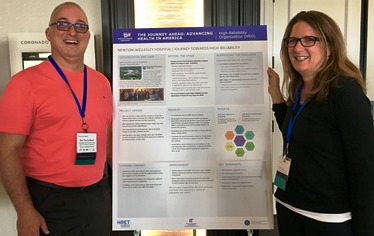
Newton-Wellesley Hospital’s Bert Thurlo-Walsh, R.N., MM, CPHQ, Assoc. CQO/V.P., Patient Experience & Medical Staff Services and Dr. Janet C. Larson, Chief Quality & Experience Officer were invited to the Health Research and Educational Trust (HRET) Hospital Improvement Innovation Network (HIIN) The Journey Ahead national conference in San Diego last month to present their hospital's poster on their journey to become a high reliability organization (HRO).  

 The HRET/HIIN conference preceded the American Hospital Association’s leadership conference.poster presentation on the hospital’s journey to become a high-reliability organization (HRO) was featured

HIIN comprises 32 state hospital associations, including MHA, and more than 1,600 hospitals collaborating to reduce inpatient harm and readmissions. For participating hospitals, HIIN provides, among other benefits, guidance and assistance for becoming an HRO.

High-reliability organizations operate in complex, high-hazard domains for extended periods without serious accidents or catastrophic failures. To become an HRO, an organization does not merely follow certain best practice processes for improving safety, but also changes its culture, ensuring that everyone on staff is ever-mindful of the need to relentlessly prioritize safety.

Newton-Wellesley’s presentation outlined its challenges—executive leadership changes and solid but stagnant patient experience and staff engagement scores—and the following steps taken toward becoming an HRO:

  • Dr. Michael R. Jaff, who became Newton-Wellesley Hospital president in October 2016, immediately made the delivery of high-quality, safe care with a great experience a primary strategy for the hospital. To achieve this strategy, Dr. Jaff focused the team on high-reliability and the elimination of harm.
  • Jaff created two new positions—Chief Quality & Experience Officer and Associate Chief Quality Officer, VP of Patient Experience and Medical Staff Services—to lead the high-reliability strategy.
  • Newton-Wellesley leveraged other hospitals in the Partners HealthCare System that had already undertaken the high-reliability journey to learn about their experiences. A core team at Newton-Wellesley then drew up strategic plans for each component of the HRO framework, along with a roadmap for implementation of each tactic.
  • Throughout the process, the hospital participated in MHA’s Clinical Issues Advisory Council and the MHA-led HIIN. It completed the Joint Commission’s Center for Transforming Healthcare ORO 2.0 tool to assist with further defining the roadmap.
  • Newton-Wellesley also added Patient Family Advisory Council members to the Patient Safety Steering Committee, and the Experience/Engagement Work Group.

The Newton-Wellesley team underscored the following key takeaways:

  • First and foremost, the journey toward HRO has no end; rather it is a continuous, never-ending journey.
  • Top leadership needs to make HRO a focus.
  • It’s important to set the quality goal as “zero harm.”
  • It is imperative to develop a “roadmap” for implementation and to use robust process improvement tools to hold leadership and staff accountable.
  • Adding patient and family advisory council members to the process through active participation in key committees also proved invaluable to Newton-Wellesley’s effort.

RI’s Westerly Hospital’s Remarkable Infection-Reduction Performance Zero

That’s the number of central line-associated bloodstream infections (CLABSI) that Westerly Hospital in Rhode Island has experienced in both its ICU and medical/surgery units from 2015 to today. Its performance in containing catheter-associated urinary tract infections (CAUTI) is equally as remarkable; in the hospital’s ICU and med/surg units there has been just one CAUTI, in the ICU, since 2016.

Westerly Hospital – a 125-bed facility that is part of Yale New Haven Health system – implemented a nurse-driven protocol to combat CAUTI. The hospital used guidelines developed by the Healthcare Infection Control Practices Advisory Committee (HICPAC) – the federal panel that advises the Centers for Disease Control and Prevention (CDC). From that, Westerly developed a CAUTI prevention algorithm for registered nurses to use, essentially to help them decide: does the patient still need the catheter or should it be removed? Such a determination could be based on a patient, say, being transferred from an ICU to another unit.

RNs assess patients on a daily, or shift, basis and follow best practices relating to removal protocols. Daily interdisciplinary rounds include reviews of all patients with urinary catheters to verify clinical indications.

“An important component is having online learning modules that educate the staff on the procedures,” said Patricia Egan, Westerly’s Nursing Professional Development Specialist. “The modules also produce a transcript that managers can use to verify that each person in the unit has passed the online lessons.” Staff were also trained in the use of the algorithm in 1:1 sessions with Nurse Leaders and Professional Development Staff.

To prevent CLABSI, Westerly set up learning stations which are essentially mock patients so that managers could observe staff performing “hands on” central IV line care and maintenance. Staff were also educated on best practices and participated in on-line learning modules. The hospitals also implemented daily Chlorhexidine Gluconate (CHG) bathing for all patients with central lines – which is recommended best practice by the CDC.

Westerly’s infection fighting strategy was developed by an inter-disciplinary team consisting of the Quality and Risk Management department, front line RNs, and Nurse Leaders. The successes are shared with staff through Westerly’s Infection Prevention Committee.

“New staff are trained on the procedures, and now that we are two years into our successful program, we are re-training all staff,” Egan said. “The program has been good for our staff, good for the hospital by avoiding value-based penalties, but especially beneficial for our patients.”

AHA’s Combating Violence in Our Communities and Our Hospitals

Our communities must work together to combat all forms of violence, now viewed as one of the major public health and safety issues throughout the country. Community action programs such as those being undertaken by our nation’s hospitals and health systems (alone and with others) are needed now more than ever to help address violence and the toll it takes on our communities and hospital colleagues.

Explore  AHA's Cost of Community Violence to Hospitals and Health Systems in this July 2017 Report   for information on national, state and local efforts to help end violence in our communities, and to help hospitals.


BID-Needham Sustaining Change: Creating a Hospital Culture of Safety

In 2013, during a period of significant institutional growth, Beth Israel Deaconess Hospital–Needham (BID–Needham) began an organization-wide effort to enhance its commitment to patient safety, employee engagement, and patient and staff satisfaction.

As a result if its efforts, BID-Needham’s scores on the AHRQ Culture of Safety Survey rose to the 98th percentile rank within one year of implementation and have been sustained since then, with the hospital’s 2016 survey scores remaining in the 96th percentile. This effort was led by the hospital’s executive leadership team with the engagement and full support of the board of directors.

For its efforts, BID–Needham was the winning entry in the “Enhancing Culture and Leadership” category of the 2017 MHA Compass Awards. Entries in each of the six Compass Award categories were voted on by non-Massachusetts judges from across the U.S., who assessed the entries “blind” – meaning there were no details to identify the hospital competing.

Since 2010, BID–Needham has conducted, through an approved vendor, the Culture of Safety survey. In 2013, the hospital set out to evaluate the hospital’s culture and the physicians’ and employees’ feelings about workplace satisfaction. Over the next year, a comprehensive evaluation of existing processes, procedures and behaviors was conducted throughout the hospital with a message to all staff and physicians of a renewed commitment to patient safety and staff engagement to find solutions.

Following the broad assessment, a hospital initiative entitled “Drive” was developed in partnership with leadership and direct line staff members. Drive focused on leadership development and accountability, employee engagement, and improving the patient experience. As part of the cultural transformation process, goals included increasing transparency and consistency of communication, creating a just and learning culture and encouraging confidence in the safety event reporting system and follow-up. Multi-disciplinary workgroups were implemented and included leadership and direct care givers. Commitment to patient safety was always central to the goals.

Since implementing the initiative BID–Needham has seen sustainment of staff confidence in the safety culture as well as improved job satisfaction. Additionally, because of the improved transparency of communication and teamwork, the hospital is able to respond more quickly and be proactive when it identifies potential problems via monthly quality surveillance (e.g., fall prevention, skin integrity, and medication events). Patient satisfaction, through HCAHPS scores, has seen consistent improvement.

Asked in the Compass Award application to list the three lessons learned, BID–Needham wrote: 1) Leadership and Board support are essential for driving transformational changes; 2) Staff engagement and partnership with leadership is essential to driving sustainable change; and 3) Transformational change occurs with commitment and organizational purpose.