Cambridge Health’s Team Culture Reduces Infections

Cambridge Health Alliance undertook an Agency for Healthcare Research & Quality-sponsored 15-month safety improvement program to reduce infections in the ICU at its Cambridge and Everett hospitals. The effort – involving an assessment of potential problems, increased staff education, use of proven best practices, leadership buy-in and more – resulted in a dramatic reduction in urinary tract infections as well as central line-associated bloodstream infections (CLABSI).

Specifically, the “working toward zero” philosophy at the health system resulted in just one CLABSI throughout 2019 and zero catheter-associated urinary tract infections (CAUTIs).

Hospitals tackling infections usually employ the comprehensive unit-based safety program (CUSP) method developed by the U.S. Department of Health & Human Services’ Agency for Healthcare Research and Quality. CUSP offers a series of toolkits to educate staff and build teamwork to get everyone on board – from frontline nurses to ancillary staff – in the effort to improve care.

The Cambridge and Everett CUSP teams consisted of the chief nursing officer, associate CNO for critical care, associate CNO for professional practice, ICU nurse managers, ICU educator, front-line staff nurses, infection preventionists, medical director of critical care, critical care doctors, and infectious disease physicians.

They first worked to define the problem, pinpointing the hospitals’ relatively high use of urinary catheters and central line devices, the lack of practice standardization, and the fact that previous safety practices and improvements were not regularly sustained. The team then determined the baseline rates of catheters and central lines, and developed an action plan to reduce them.

To improve the caregiver-patient link they instituted the “AIDET” communications framework, which is a process from the Studer Group that stresses five communications behaviors: Acknowledge, Introduce, Duration, Explanation, and Thank You. To improve nurse-to-nurse communication, they instituted a standard process for each patient handoff. CAUTI and CLABSI “prevention bundles” were developed to ensure standard protocols relating to decision-making, insertion, assessment and documentation, line care, removal, and more. A whole host of other detailed, step-by-step, repeatable processes were laid out and re-emphasized in ongoing team education programs.

Developing a culture of safety in a do-no-harm environment was established by creating modality bundles for CAUTI and CLASBI. This was the framework for the nursing staff in the ICU to consistently follow a strategic process that resulted in measurable outcomes.

Lynette M. Alberti, R.N., Cambridge Health Alliance’s Senior Vice President and Chief Nursing Officer, said, “While achieving zero harm may seem impossible, it is not. This work is an important step in our journey to becoming a high-reliability, zero-harm organization.” That statement has been the driving force behind the facility’s effort to build a culture of safety.

Perhaps the biggest improvement at Cambridge was a re-emphasis on the “culture of safety,” meaning that anyone on the team – but especially the front-line nurses – can question at any time the need, or continued need, for line/tube insertion. “Safety Bedside Shift Reporting” with the patient has become a new standard of practice and a key driver of reducing harm events in both hospitals. “Multidisciplinary rounding” means the team gathers and gets to talk openly about how the central lines and catheters are being employed.

Patricia Noga, R.N., MHA’s VP for Clinical Affairs, said the path Cambridge Health Alliance took for its improvement project is similar to what is occurring at other hospitals across Massachusetts.

“The sort of improvements in care that Cambridge Health Alliance showed in this project is contingent on a committed team ensuring that each step for every patient is given the team’s unwavering attention and best practice implementation,” she said. “It’s easy to waver from tried and true processes but CHA’s results show that creating a culture where all voices are listened to and respected ensures that everyone is more apt to stay on the path towards improvement.”

Hebrew SeniorLife & Brown to Lead National Alzheimer’s Project

Hebrew SeniorLife and Brown University have received a five-year $53.4 million grant from the National Institute on Aging (NIA) to lead a comprehensive, nationwide effort to address Alzheimer’s disease and related dementias. NIA is a division of the National Institutes for Health.

 The funding will support the creation of a research incubator or “collaboratory”, bringing together 30 research institutions throughout the United States to conduct pilots to test non-drug, care-based interventions for people living with dementia, and also to develop best practices for implementing and evaluating interventions for Alzheimer’s and dementia care and share them with the research community.

 Dr. Susan Mitchell, senior scientist at Hebrew SeniorLife’s Hinda and Arthur Marcus Institute for Aging Research and professor of medicine at Harvard Medical School is co-leader of the collaboration, along with Dr. Vincent Mor, professor of health services, policy and practice at Brown’s School of Public Health.

 Pilot projects throughout the country will benefit from the collaboratory’s experts, who will assist with ethical concerns (such as how to secure informed consent from people living with dementia); technical support and generation of data on participant populations; statistics and project design; advice on how to measure patient- and caregiver-reported outcomes; dissemination of results and efforts to maximize the likelihood of implementation; partnering with healthcare systems interested in conducting trials; project administration; training for junior researchers; inclusion of and applicability to people of all backgrounds and cultures; and best practices to engage people interested in this work, including people living with dementia and their caregivers.

 “It’s time for Alzheimer’s and other dementias to receive the same level of research focus and investment as cancer,” said Louis Woolf, HSL president and CEO. “We’re proud to collaborate with Brown University to address this national epidemic that affects not only patients, but their families and caregivers as well.”
Activating Wellness Program Participation

What we need to do differently to generate enthusiasm and increase participation.

There is definitely an art to creating enthusiasm and generating participation in your company’s worksite wellness initiative.

From our perspective, based on practices of Well Workplace Award winning companies, we suggest organizing your participation with the some ideas.

Read more…

ANA – Issue Brief – Reporting Incidents of Workplace Violence

Reporting Incidents of Workplace Violence Effective Date: 2019 Overview

The rate of violence against health care workers has reached epidemic proportions. According to a 2012 report by the U.S. Government Accountability Office (GAO), health care workers in inpatient facilities experienced workplace violence-related injuries requiring days off from work at a rate at least five to 12 times higher than the rate of private-sector workers overall. This type of violence includes incidences of violence against registered nurses (RNs) by patients, patients’ family members and external individuals, and it includes physical, sexual and psychological assaults.

Read more…

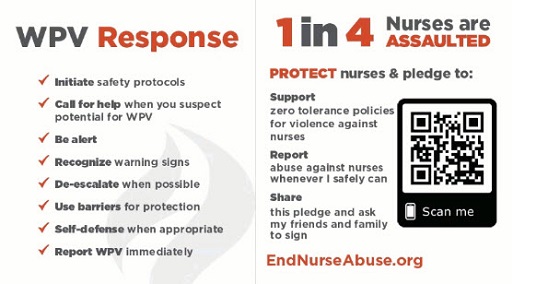
Protect Yourselves, Protect Your Patients

The American Nurses Association (ANA) convened a professional issues panel to develop policy and identify strategies to address barriers to nurses and other health care workers reporting violence and abuse, and to strengthen ‘zero-tolerance’ policies.

This under-reported epidemic has devastating results on the healthcare industry. Studies show that WPV can affect the quality of care and care outcomes, contribute to the development of psychological conditions, and reduce the RN’s level of job satisfaction and organizational commitment.

Read more…

Section 35 Petitions – Standard Medical Information Release

Section 104 of Chapter 208 of the Acts of 2018 creates the Section 35 Commission and directs the commission, in part, to evaluate and develop a proposal for a consistent statewide standard for the medical review of individuals who are involuntarily committed due to an alcohol or substance use disorder pursuant to section 35 of chapter 123 of the General Laws. The commission’s full scope is available here.

With regard to the commission’s charge to develop a standard for the release of medical information, MHA convened a workgroup of hospital legal and clinical staff from across the commonwealth. MHA’s goal was to develop consistent statewide standards for the medical information required to be released to court clinicians; MHA had heard members’ concerns about the different processes courts follow for submission of medical documentation in support of a Section 35 petition, as well as medical staff confusion when interacting with more than one court. Please note that the following materials are designed to supply the courts with necessary medical information, and were not developed to change the overarching Section 35 process.

MHA worked closely with the Trial Court and DMH court clinicians to ensure the information would be acceptable and helpful to the courts when making a determination on the petition, and with care coordination following the court hearing. In addition, MHA worked with Dave Szabo, a partner, co-chair of the healthcare practice, and member of the privacy group at MHA’s member law firm Locke Lord, to provide a legal memo outlining the legal permissions within federal and state laws for sharing the information to the courts in the manner outlined in the attached materials.

The materials we are requesting members use include:

  • Section 35 – Affidavit Letter: This is a template letter that MHA asks each provider to complete and attach to the “Affidavit in Support of Petition for Commitment under G.L. 123, Section 35.” Please note that the provider should not complete the actual affidavit form (available here), but indicate on the form, “See Attached Affidavit Letter.”
  • Section 35 – Checklist for Affidavit Letter: This is a reference guide for the hospital/clinician to understand what essential medical information is needed in the “Affidavit Letter” and additional medical information to be attached to the letter (lab and/or medication lists). Providers should not include additional information that is not listed on this checklist.
  • Section 35 – Privacy Memo: As outlined above, this is the legal memo provided by David Szabo, which was reviewed by the courts and EOHHS, which provides assurances that the information provided by a clinician to the court, as outlined in the documents above, would not be in violation of federal HIPAA or state privacy laws.

ONL’s Nursing Summit 2019 Report

In January 2019, Organization of Nurse Leaders, MA, RI, NH, CT, VT (ONL) led ten nursing organizations through a Nursing Summit in central Massachusetts to bring nurses together, hear their concerns and feedback, and enhance trust among nurses. The Nursing Summit focused on engaging clinical nurses, listening, and elevating their voice. Every person in the room was a Registered Nurse (RN). By design, all roles and titles were removed from name badges to eliminate hierarchy and enhance open and honest dialogue about the state of nursing. The Nursing Summit was an opportunity to celebrate professional nursing and to remind ourselves why we chose this profession and why we decide to stay.

Read more…