


The Massachusetts Consultation Service for Treatment of Addiction and Pain (MCSTAP) offers real-time, telephonic professional consultation to primary care providers and emergency department clinicians on safe prescribing and managing care for patients with chronic pain and/or substance use disorder (SUD). It also provides resource and referral information about community-based providers, programs, and services to support patients with chronic pain and/or SUD.
Author: admin
Task Force Issues 17-Step Guidance to Reduce Sepsis in EDs
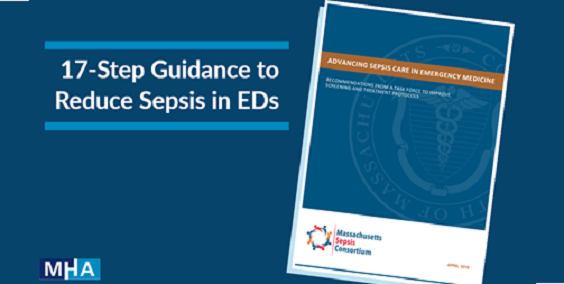
The Massachusetts Sepsis Consortium, led by the Betsy Lehman Center for Patient Safety, has released a report — Advancing Sepsis Care in Emergency Medicine — containing 17 recommendations that hospitals and emergency departments can undertake to reduce incidences of sepsis.
Sepsis – the body’s extreme response to an infection that can lead to rapid tissue damage, organ failure and death if not treated quickly – is among the top causes of 30-day hospital readmissions in Massachusetts and is the third leading cause of the state’s hospital inpatient deaths.
Combatting sepsis is difficult. The symptoms of it are vague and easily confused with other conditions. There’s no definitive blood test to determine if a patient has sepsis. And there is no definite guidance from specialty societies on how to treat or report it. For example, most hospitals follow CMS’s “SEP-1” guidelines, which require extensive reporting. But many large insurance companies are now requiring international Sepsis-3 guidelines that mandate an entirely different form of reporting.
The Consortium’s report notes, “Despite these challenges, there are best practices on which most experts agree and for which there is well-established peer reviewed evidence.” The Sepsis Consortium, of which MHA is a founding member, decided that since most patients with sepsis enter the health system through the hospital ED, it would launch a special task force to develop ED protocols. That task force was chaired by Thomas Amoroso, M.D., medical director for utilization management at Commonwealth Care Alliance, and John J. Walsh, M.D., an emergency medicine physician at South Shore Hospital and the task force’s Mass. Medical Society representative. Every hospital in the state sat for interviews to help inform the task force’s work.
The task force recommendations focus on seven areas: adult screening and treatment; pediatric screening and treatment, patient management, appropriate antibiotic use, staff education and feedback, and patient education.
The Coalition says the focus on sepsis in the ED is “only one piece of the larger puzzle” and that in coming reports it would address sepsis in other care settings.
CARE ACT: Implementation of Chapter 332 of the Acts of 2016, Discharge Planning

In an effort to support caregivers and those they care for, Governor Charlie Baker signed into law chapter 332 of the acts of 2016, an act authorizing the disclosure of medical information to certain designated caregivers, which authorizes all acute care hospital patients 18 years of age or older receiving inpatient services to designate a caregiver and requires hospitals to discuss with the patient and caregiver the patient’s known aftercare needs and provide a demonstration of the aftercare tasks.
2019 Day-to-Day Employee Celebration Calendar

Make 2019 the year you energize your organization with a coordinated employee recognition program that builds a fun, happy, engaged, and productive workplace! At gThankYou, they know how to hit “refresh” on workplace culture. They’re experienced at helping companies of all sizes and industries celebrate employees. We understand what goes into building a sustainable, vibrant culture of gratitude, and the importance of planning ahead to keep engagement goals on track.
Employee recognition is about so much more than end-of-the-year dinners and employee- of-the-month plaques. The most successful businesses know the importance of celebrating employees day in and day out!
Your How-to Guide for Building an Everyday Culture of Appreciation - 2019
Caring for Patients with Alzheimer’s Disease and Related Dementias
In June 2017, the state’s Alzheimer’s and Related Dementias Acute Care Advisory Committee issued its final report with a goal of outlining strategies to provide optimal care to persons with dementia in acute care settings.
How can we make health care more age friendly?

By creating age-friendly health systems that fundamentally rethink the way we care for older adults. It will require establishing a continuum of care that anticipates needs and engages older adults and their families in health care planning. In many cases, it will mean deploying a mix of care solutions with personalized support services aimed at ensuring a better life for older adults with chronic conditions. To accomplish this, health care leaders must make age-friendly care a priority.
Webinar-Up-Close Look at Violence & Violence Prevention

Healthcare workers are often the target of verbal and physical violence from patients. Hospitals, aware of the trend, are continually making strides to protect their workforce.
Recently, a national webinar hosted by the AHA’s Health Research and Educational Trust (HRET) featured MHA and Harrington Healthcare System’s Elise Wilson, R.N., who was violently attacked while caring for a patient.
MHA’s V.P. for Clinical Affairs, Patricia Noga, PhD, R.N., discussed MHA’s statewide efforts to prevent and mitigate workplace violence, as well as MHA’s Caring for the Caregiver initiative that focuses on gratitude, workplace safety, and employee well-being.
Elise Wilson shared her compelling story of the assault against her, her injuries, and the aftermath of the event. And Carlton Rondeau, Manager of Public Safety at Harrington, described the hospital’s response to the event and efforts to prevent workplace violence through enhancements in physical security measures, emergency preparedness activities, and education and awareness.
MHA’s Efforts to Address Healthcare Violence
Over the last year, MHA convened an interdisciplinary group of hospital staff to identify strategies to address incidents of violence in the workplace. This group consisted of nursing staff, security professionals, risk managers, and others. Its intent was to develop statewide standards and policies that provide a baseline for safety practices and to support adoption of said standards in every hospital. Knowing that each hospital and the communities that they serve are unique, the work group ensured that hospitals and healthcare facilities had the flexibility to include additional resources or interventions to support successful implementation.
As a result, the MHA Workplace Safety and Violence Prevention Work Group developed this Healthcare Safety Violence Prevention Guidance. Its key recommendations for hospitals include:
- Development of a broad-based multidisciplinary committee to design, implement, modify, and evaluate a workplace violence prevention program and drive system level improvements;
- Adopting policies and procedures supporting industry best practices for facility space design, security technology, and patient management; and
- Supporting and empowering employees by giving them, through education and training, the tools they need to manage aggressive behavior in patients, visitors, and others within a facility, and showing them appropriate methods for responding to and reporting incidents.
What is Palliative Care?”

Webinar Recording (Time: 5 minutes) – For Everyone: Learn why Palliative Care is an added layer of support for individuals with serious illness- at any age, any serious illness, and any phase of health.
For Consumers: “Palliative Care: Aligning the Team Around the Patient”

Webinar Recording (Time: 30 minutes) – For Consumers, Patients, Families and Caregivers can explore Palliative Care and learn key questions to start a discussion with your care providers. Elizabeth J.Collins, MD, Palliative Care Medical Director, Lahey Hospital & Medical Center, provides a framework of the 5 stages of serious illness and how palliative care can be effective at each stage and all through a serious illness.