National Healthcare Decisions Day 2025

This National Healthcare Decisions Day, MHA and our coalition members encourage you to take the simple steps necessary to take charge of your healthcare.
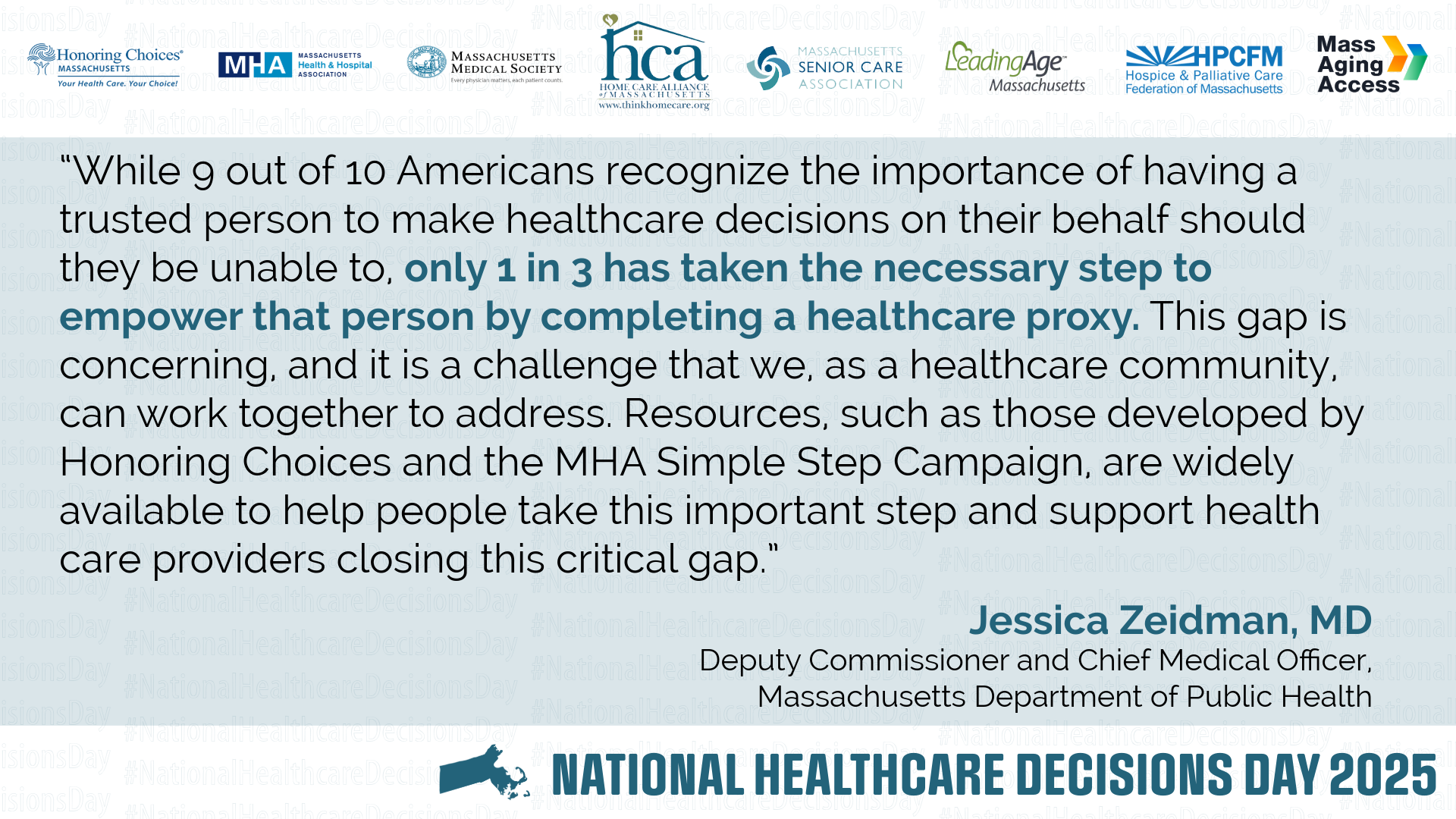
The coalition is highlighting three key steps for community members:

  1. Choose someone you trust to be your designated healthcare agent and have a simple conversation about what’s important to you.
  2. Complete a health care proxy form – you can do it all yourself! (This form from Honoring Choices Massachusetts is available in 15 languages.) You can also complete a form that comes directly from your healthcare provider.
  3. Have a simple conversation with your care team about the care that’s right for you.

Completion of a health care proxy, the simple form patients can use to assign their agent, can also help alleviate some of the intense pressures healthcare organizations are experiencing. Proxies empower caregivers to work directly with trusted loved ones and efficiently transition them to other care settings from the moment their hospital stay is winding down. Hospital case managers report that when patients lack a healthcare agent, it prevents them from being discharged and ties up acute-level beds for other patients in need. Patients do not get the level of care they need, while hospital wait times and care access for other individuals suffer.

Read more about the effort and partner resources here.

A Simple Step: A Call for Long-Term Healthcare Planning

Amidst persistent capacity constraints within Massachusetts healthcare facilities, a coalition of leading organizations has renewed its call for proactive care planning by urging community members to take the simple step of designating a healthcare agent and completing a health care proxy.

The coalition is calling on every patient to designate a healthcare agent, or the person trusted to make care decisions on your behalf if you are unable to make them for yourself. The importance of proactive decision-making became especially evident during the COVID-19 pandemic, when thousands of patients across the nation were incapacitated and in need of representation regarding their care.

Capacity constraints have been a relentless challenge for a the commonwealth’s healthcare system in recent years. Completing a healthcare proxy is a simple step that adults over age 18 can take to ensure that they have a trusted representative making decisions on their behalf should they become incapacitated.

The coalition is highlighting three key steps for community members:

  1. Choose someone you trust to be your designated healthcare agent and have a simple conversation about what’s important to you.
  2. Complete a health care proxy form – you can do it all yourself! You can also complete a form that comes directly from your healthcare provider.
  3. Have a simple conversation with your care team about the care that’s right for you.

    Completion of a health care proxy, the simple form patients can use to assign their agent, can also help alleviate some of the intense pressures healthcare organizations are now experiencing. Proxies empower caregivers to work directly with trusted loved ones and efficiently transition them to other care settings from the moment their hospital stay is winding down. Hospital case managers report that when patients lack a healthcare agent, it prevents them from being discharged and ties up acute-level beds for other patients in need. Patients do not get the level of care they need, while hospital wait times and care access for other individuals suffer.

    Read more about the effort and partner resources here.

    Watch our latest webinar on taking a Simple Step below:

    How Community Members Can Help A Stressed System

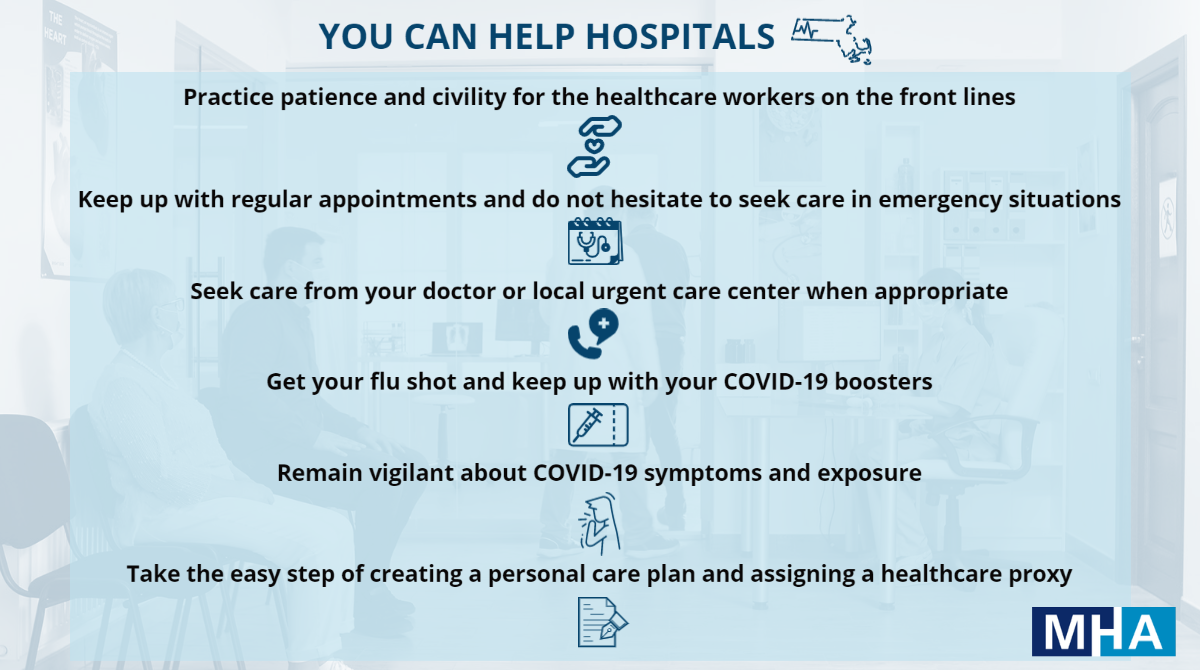
    As healthcare organizations and caregivers navigate another challenging winter, the Massachusetts Health & Hospital Association is sharing these basic measures that community members can take to help support the system:

    • Practice patience and civility for the healthcare workers on the front lines
    • Keep up with regular medical appointments and do not hesitate to seek care in emergency situations
    • Seek care from your doctor or local urgent care center when appropriate
    • Get your flu shot and keep up with COVID-19 boosters
    • Remain vigilant about COVID-19 symptoms and exposure
    • Take the easy step of creating a personal care plan and designating a health care proxy

    We welcome you to share the full graphic below:

    Massachusetts e-MOLST Web Portal

    New VIDEO. Introduction to MA e-MOLST Web Portal for Honoring Choices Partners. Share with your clinicians and care teams.

    Tools & Resources to Use the Portal Start Proactive Planning Conversations & Document Care Choices
    The MA e-MOLST Web Portal offers health care providers and seriously ill, high-risk, and frail adults an effective communication approach to engage in proactive care planning conversations and document patient care choices in MA planning documents.

    The web portal provides easy access to Ariadne Labs Serious Illness Conversation Guides, an electronic MA MOLST form (Medical Orders for Life-Sustaining Treatment), and links to complete a multi-lingual MA Health Care Proxy. The MA e-MOLST Web Portal is a joint pilot project of the Massachusetts Coalition for Serious Illness Care, Ariadne Labs, and Honoring Choices Massachusetts with support from Vynca, Inc.

    Clinicians and their care teams can:

    Start a serious illness conversation and understand what matters most

    Download Ariadne Labs Serious Illness Conversation Guides

    Document patient care choices in a MA MOLST form

    If the patient chooses, complete the e-MOLST form in the web portal (English only)

    Alternatively, download and complete a multi-lingual MOLST form, and upload to the web portal

    Help ensure adults have a Health Care Proxy. Simply ask: “Do you have a Health Care Agent?”

    If yes, check that a valid, up to date Health Care Proxy is in the patient record

    If no, download and complete a multi-lingual Honoring Choices Health Care Proxy

    Read more…

    Music on Our Minds: The Rich Potential of Music to Promote Brain Health and Mental Well-Being

    The Global Council on Brain Health (GCBH) is an independent collaborative of scientists, health professionals, scholars, and policy experts from around the world who are working in areas of brain health related to human
    cognition. The GCBH focuses on brain health relating to people’s ability to think and reason as they age, including aspects of memory, perception and judgment. AARP convened the GCBH to offer the best possible
    advice about what older adults can do to maintain and improve their brain health. GCBH members gather to discuss specific lifestyle issue areas that may affect people’s brain health as they age, with the goal of providing
    evidence-based recommendations for people to consider incorporating into their lives.

    Many people across the globe are interested in learning that it is possible to influence their own brain health and in finding out what can be done to stay as sharp as possible as they age. We aim to be a trustworthy source
    of information, basing recommendations on current evidence supplemented by a consensus of experts from a broad array of disciplines and perspectives.

    Knowledge about brain health is expanding rapidly. GCBH’s work empowers individuals to benefit from insights on the cutting edge of science and enhance well-being through the course of their lives.

    Read more…

    Milford Regional Medical Center – Preparing for the Workforce with Project SEARCH

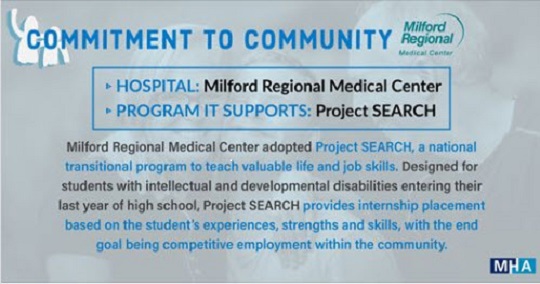
    Milford Regional Medical Center adopted Project SEARCH, a national transitional program to teach valuable life and job skills.  Designed for students with intellectual and developmental disabilities entering their last year of high school, Project SEARCH provides internship placement based on the student’s experiences, strengths and skills, with the end goal being competitive employment within the community.

    Read more…

    Betsy Lehman Center for Patient Safety

    The Betsy Lehman Center for Patient Safety is a Massachusetts state agency that works with providers, patients and policymakers to advance the safety and quality of health care. Visit its website for actionable toolkits to improve safety in areas such as emergency medicine, sepsis, cataract surgery and more. Sign up for the Center’s monthly newsletter, Patient Safety Beat, for updates on local patient safety news and research.

    The Center is also working with hospitals and outpatient practices across Massachusetts to help each develop its own sustainable peer support programs. This is part of a larger effort by the Center to ensure that all individuals – patients, family members, health care professionals and staff – affected by medical harm or a difficult outcome get the support they need.