CRITICAL SHORTAGES AHEAD: Aligning the Nursing and Allied Health Education Pipeline with Growing Demand

A new report shows that that employer demand far exceeds the supply of workers in six key nursing and allied health fields, which will have “substantial and unsustainable consequences” for the state’s healthcare sector and economic opportunity.
Critical Shortages Ahead: Aligning the Nursing and Allied Health Education Pipeline with Growing Employer Demand was produced in partnership by the MassINC Policy Center, MHA, the Massachusetts Association of Community Colleges, and the Richard and Susan Smith Family Foundation.

The six target occupations featured in the report are: licensed practical nurses, associate degree registered nurses, medical/clinical laboratory technicians, respiratory therapists, surgical technologists, and radiologic technologists/radiographers.

While the shortage of workers grows, so has the desire of students to enter the healthcare field; the number of qualified students seeking education for these occupations from Massachusetts community colleges exceeds expected programmatic capacity by at least two to one, according to the report. Community college programs for the six occupations currently draw about 4,500 applicants, but they only have the capacity to enroll around 2,200 students.

The imbalance is most severe for radiological technologists, where programs have five qualified applicants for each available seat. Also of concern, large geographic gaps in education capacity exacerbate the workforce shortage in some parts of the state, the report found.

While the report acknowledges the current, ongoing efforts to build the workforce, it concludes that more action is needed. Specifically, the report calls for increasing the number of clinical placements and clinical educators by, among other things:

  • Addressing faculty compensation;
  • Creating a state regulatory environment supportive of expanding nurse education capacity; and
  • Developing “longitudinal data systems” to follow students through education, licensing, and into the workforce.

The report data was collected from surveys of certificate and degree programs associated with the six target occupations, as well as surveys of human resources leaders from acute care hospitals and long-term care providers, supplemented by data collected from federal and state sources.

“These nursing and allied health professionals are vital members of both acute and post-acute care teams, and essential to hospital operations,” said Kim Stevenson, MHA’s director of workforce and clinical affairs. “The joint report gives us a first-of-its-kind look at the gaps and the barriers in creating these positions, and recommendations for how we can work collectively to find solutions to bring better balance to the supply and demand for caregivers.” 

Educators and providers identified three key obstacles to expanding enrollment to meet student demand: insufficient clinical placements, faculty and program leadership shortages, and state regulatory barriers for nursing

The inability to educate and train the next generation of healthcare workers is leading to three troubling developments, according to the report:

  • First, “In occupations facing severe labor shortages, persistent turnover creates a costly cycle that undermines the quality, accessibility, and affordability of care.”
  • That leads to the second problem – the high cost of temporary labor. “Survey respondents for both acute and long-term care organizations reported a combined $232 million in annual spending on temporary agency staff,” the report notes. “Extrapolating from these figures to all Massachusetts employers, the actual agency spend for these six occupations alone likely exceeds $450 million.”
  • Finally, the critical shortages of key healthcare workers results in the difficult to quantify “lost economic opportunity” for students, who don’t have a chance to participate in meaningful, well-paying jobs and often don’t have a fallback position.

“Massachusetts is world-renowned in the field of healthcare, and yet we are facing a dire workforce shortage in some of the most critical healthcare occupations,” said William Heineman, president, North Shore Community College and chair of the Community College Council of Presidents. “The Massachusetts Community Colleges are grateful to have partnered with the MassINC Policy Center, the Massachusetts Health & Hospital Association, and the Richard and Susan Smith Family Foundation to identify existing barriers and brainstorm solutions to ensure that we are meeting the demands of the field. This collaboration is exactly what is needed to maintain Massachusetts’ reputation as a leader in the industry moving forward.”

This update offers newly revised strategies for a comprehensive approach to healthcare safety and violence prevention across healthcare facilities, including emergency departments, inpatient settings, outpatient clinics, mobile health services, and home healthcare. It also recognizes that because every healthcare organization has its own unique needs, structures, economics, patient populations, and workforce environments, each entity’s response to workplace violence will be different. There is no one single way to implement a workplace violence strategy for a healthcare setting, but these collected strategies can assist.

Over the last few years, the HSVP’s accomplishments include adopting and reporting on a standardized data collection tool, creating a united set of principles for patient-visitor codes of conduct, providing regular education opportunities to disseminate safety and violence prevention strategies from local and national leaders, and advocating for federal and statewide policy changes related to healthcare worker protections. Taken together, these efforts have helped make Massachusetts a recognized national leader in healthcare safety and violence prevention and prompted collaboration and publications with colleagues across the country.

MHA’s Guidelines for Healthcare Safety and Violence Prevention (2025 Update)

In response to the increased risk of violence in healthcare settings, the Massachusetts Health & Hospital Association’s Healthcare Safety and Violence Prevention Workgroup (HSVPW) developed guidance to help healthcare facilities use evidence-based practices to create effective healthcare violence prevention programs.

This update offers newly revised strategies for a comprehensive approach to healthcare safety and violence prevention across healthcare facilities, including emergency departments, inpatient settings, outpatient clinics, mobile health services, and home healthcare. It also recognizes that because every healthcare organization has its own unique needs, structures, economics, patient populations, and workforce environments, each entity’s response to workplace violence will be different. There is no one single way to implement a workplace violence strategy for a healthcare setting, but these collected strategies can assist.

Over the last few years, the HSVP’s accomplishments include adopting and reporting on a standardized data collection tool, creating a united set of principles for patient-visitor codes of conduct, providing regular education opportunities to disseminate safety and violence prevention strategies from local and national leaders, and advocating for federal and statewide policy changes related to healthcare worker protections. Taken together, these efforts have helped make Massachusetts a recognized national leader in healthcare safety and violence prevention and prompted collaboration and publications with colleagues across the country.
AHA Issue Brief: Building a Safe Workplace and Community — Violence Mitigation in a Culture of Safety

The American Hospital Association’s Hospitals Against Violence (HAV) initiative hosted the American Society for Health Care Risk Management (ASHRM) for a facilitated dialogue to explore challenges and current strategies to mitigate the risk of violence. The discussion fostered an exchange of ideas and solutions that informed this issue brief and accompanying case studies.

From AHA:

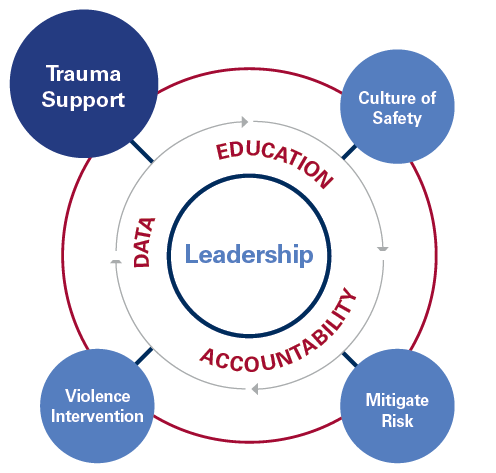
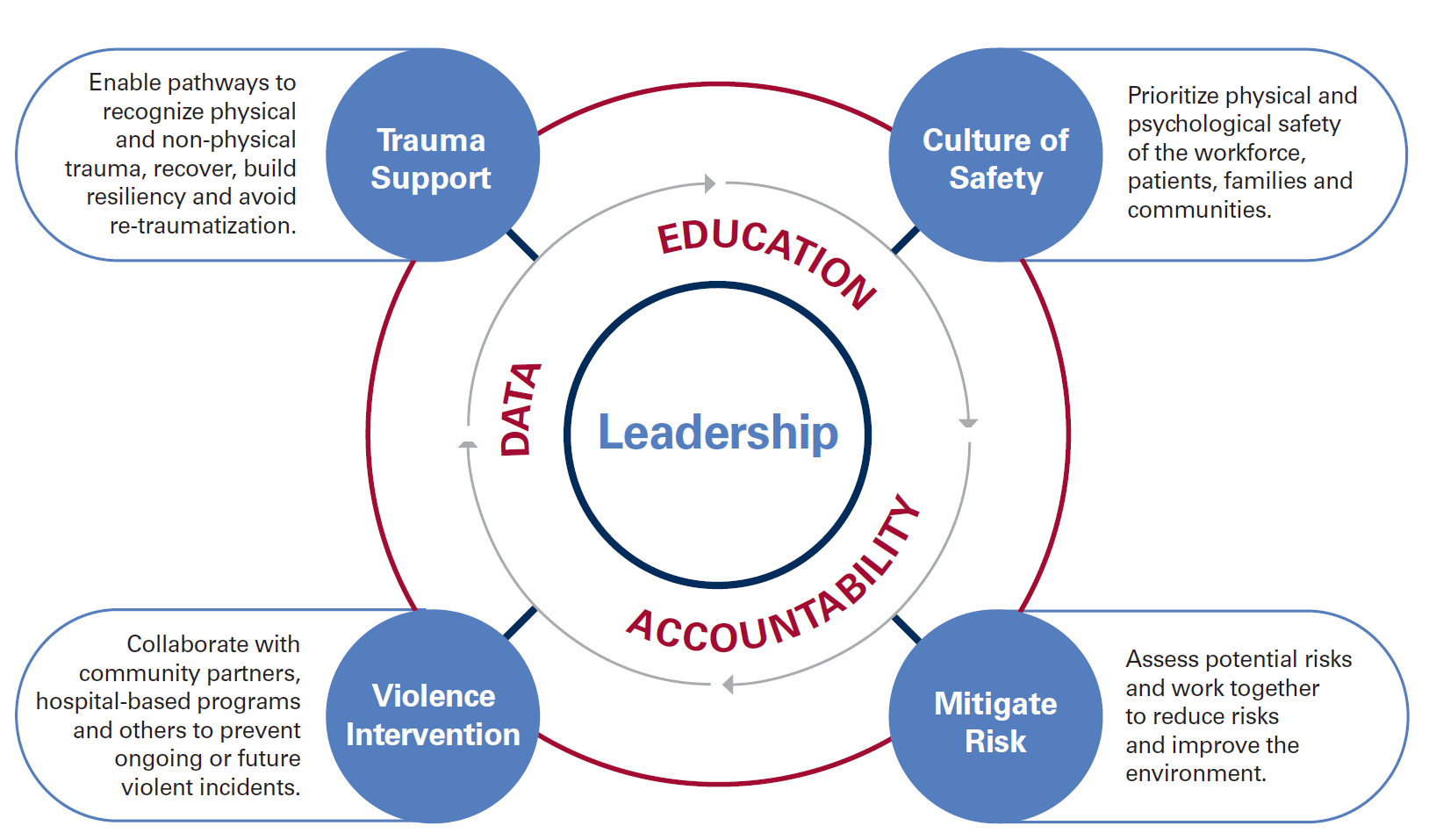
In 2021, HAV developed the Building a Safe Workplace and Community framework to guide health care leaders in their efforts to prevent and mitigate violence.

This issue brief, the third of four in the series, examines how hospitals’ violence mitigation efforts can fit effectively into an organization’s culture of safety strategy. The brief includes thought-provoking questions to facilitate discussion of how violence mitigation can be integrated seamlessly into the larger framework of patient and worker safety initiatives, supporting an overall culture of safety. It also explores strategies that leaders could take to best support a culture that mitigates violence as part of larger enterprise efforts.

View the issue brief here.

AHA Issue Brief: Building a Safe Workplace and Community — Providing Trauma Support to Your Workforce Following an Incident or Threat of Violence

The American Hospital Association’s Hospitals Against Violence (HAV) initiative hosted the American Society for Health Care Risk Management (ASHRM) for a facilitated dialogue to explore challenges and current strategies to mitigate the risk of violence. The discussion fostered an exchange of ideas and solutions that informed this issue brief and accompanying case studies.

From AHA:

In 2021, HAV developed the Building a Safe Workplace and Community framework to guide health care leaders in their efforts to prevent and mitigate violence.

This issue brief examines trauma support for hospital and health system team members. It was developed from discussions the HAV Advisory Group had with the Medical University of South Carolina’s National Mass Violence Victimization Resource Center (NMVVRC) team about the challenges and opportunities to provide trauma support to health care workers following an incident or threat of violence.

View the issue brief here.

AHA Building a Safe Workplace and Community: A Framework for Hospital and Health System Leadership

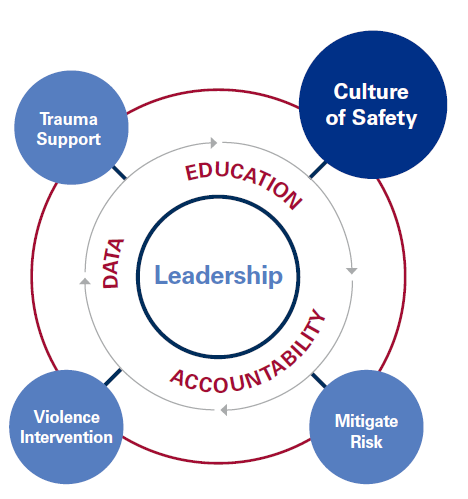
The American Hospital Association’s Hospitals Against Violence (HAV) initiative hosted the American SAHA’s Hospitals Against Violence framework helps guide hospital and health system leadership address the issues of violence in their workplaces, with an emphasis on educating and protecting the workforce. In this effort, we must acknowledge that community violence encroaches into the health care setting, and our workforce is part of the community.

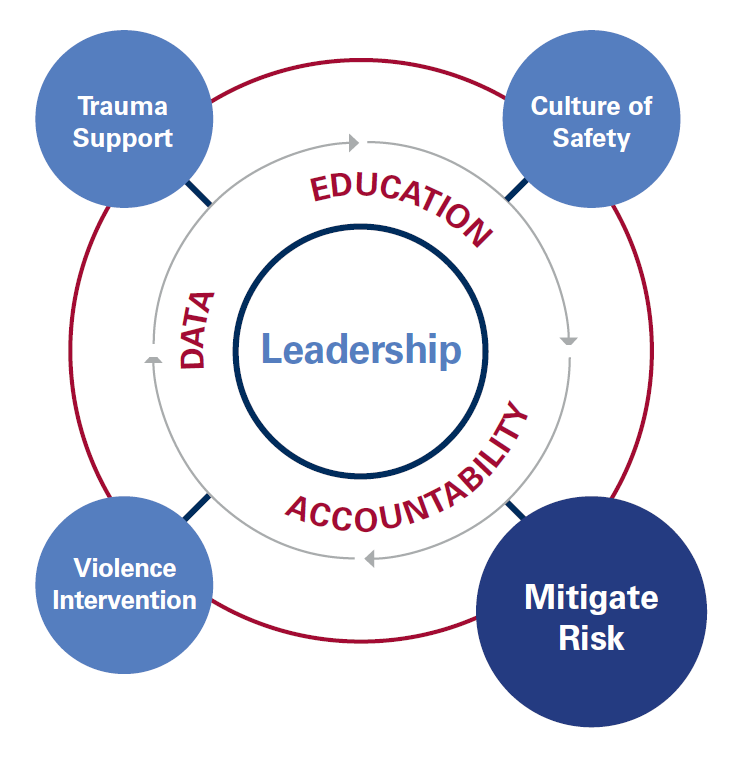
Leadership should push for greater data collection, collective accountability, and ongoing education and training. With this approach, we can achieve the four pillars necessary for implementing a comprehensive violence mitigation strategy: trauma support, violence intervention, culture of safety and mitigating risk.

To learn more about the AHA’s Hospitals Against Violence
initiative, visit www.aha.org/HAV.

Download a PDF of the framework here.

AHA Issue Brief: Building a Safe Workplace and Community — Mitigating Risk of Violence

The American Hospital Association’s Hospitals Against Violence (HAV) initiative hosted the American Society for Health Care Risk Management (ASHRM) for a facilitated dialogue to explore challenges and current strategies to mitigate the risk of violence. The discussion fostered an exchange of ideas and solutions that informed this issue brief and accompanying case studies.

From AHA:

In 2021, HAV developed the Building a Safe Workplace and Community framework to guide health care leaders in their efforts to prevent and mitigate violence.

This issue brief examines risk mitigation and marks the first in a series that expand on each domain of the framework: culture of safety, violence intervention, trauma support and risk mitigation. This issue brief is an outgrowth of a series of discussions between hospital and risk management leaders. The brief shares considerations when assessing potential risks, strategies to mitigating violence and insights on making the care environment safer.

View the issue brief here.

American Society for Healthcare Risk Management, Workplace Violence Toolkit

Violence in the workplace continues to be an area that risk managers need to be proactively preparing their institutions to prevent. At the same time, the risk manager needs to know what to do in the event they are faced with an immediate situation. This tool kit is designed to assist in both of these areas.

Read more…

The Joint Commission, Improving Patient & Worker Safety: Opportunities for Synergy, Collaboration, & Innovation

This monograph is intended to stimulate greater awareness of the potential synergies between patient and worker health and safety activities. Using actual case studies, it describes a range of topic areas and settings in which opportunities exist to improve patient safety and worker health and safety activities.

Read more…

OSHA, Safety and Health Management Systems: A Road Map for Hospitals

A safety and health management system is a tool to help turn this situation around: a proven, flexible approach to proactively and continually address workplace safety and health issues.1 It provides the overarching framework for planning, implementing, evaluating, and improving all workplace safety and health management efforts.

Read more…

OSHA, Safe Patient Handling Programs: Effectiveness & Cost Savings

The Safe Patient Handling Programs: Effectiveness and Cost Savings document gives administrators a business case for investing in safe patient handling programs, policies, and equipment, based on real-life findings from hospitals across the United States that have successfully implemented these programs.

Read more…